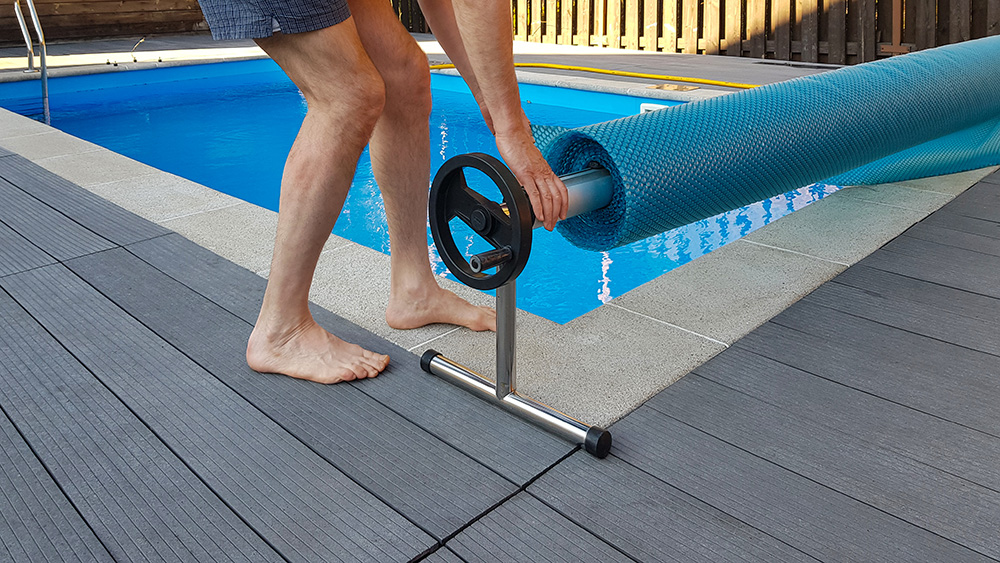
Installing a pool can involve a seemingly endless series of decisions — location, design, interior finishes, tiles, deck materials, fencing options, equipment alternatives and more.
Little wonder, then, that the humble pool cover or blanket is often overlooked or deemed less important than, say, a robotic cleaner. Nothing could be further from the truth.
Occasionally, you’ll encounter aspects of pool ownership that make it clear you’re learning on the fly — like one season of leaf litter drop from your neighbour’s eucalyptus tree, for example.
Previously innocuous situations can take on a whole new light when viewed through the lens of pool ownership. Before you decide a pool blanket is not for you, read on to learn more about the benefits.

Straight up — a pool or spa blanket keeps debris including leaves, twigs and dirt out of your pool. Obvious, right? Sure, but using a blanket will keep between 80 and 90% of potential debris from entering the water, so it’s hard to see why you wouldn’t use one. We may live in the days of robotic cleaners, rather than a manual sweep and scoop to keep the pool pristine, but 80–90% is significant. Fewer leaves in the water means less load and stress on your cleaner, which can only be a good thing. Most robotic cleaners will continue to operate with a cover or blanket in place.
When the ambient temperature falls below the water temperature (usually at night), it results in water cooling, evaporation and convection heat loss. The way to combat this issue is by creating a barrier between the water surface and the outside air using a pool cover or blanket.
Evaporation obviously leads to increased water usage, but it also contributes to higher chemical costs. When water is lost and your pool needs to be topped up, you’ll need to add more chemicals in order to rebalance the water. Direct sunlight also breaks down chlorine, so using a cover helps minimise the effects.
Around 90% of heat loss in a swimming pool occurs at the surface. By using a blanket, heating costs are reduced — by up to 50% in some cases. If you’re using a blanket in conjunction with gas, electric or solar heating systems, you can achieve significant cost savings.
Using a blanket helps extend the swimming season, letting you enjoy the pool for more of the year. Even without other forms of pool heating, the addition of a blanket can result in a six- to eight-degree temperature increase in a pool that has a sunny aspect.
There are many options available, so you’ll need to do some research — automatic, manual, solar, safety, thermal and more. Your specific pool type and design will dictate to some degree, as will budget, sense of style and your typical usage habits. Whatever option you select, make sure it is a precise fit, as gaps around the edges will reduce the overall efficiency.
To get the most out of your pool cover, don’t treat it as a ‘set-and-forget’ installation. Ensuring proper care and maintenance using the following tips will extend its life.